
Gaza and the analysts
The CIA's real error may have been buying into the disengagement 'konzeptiya'

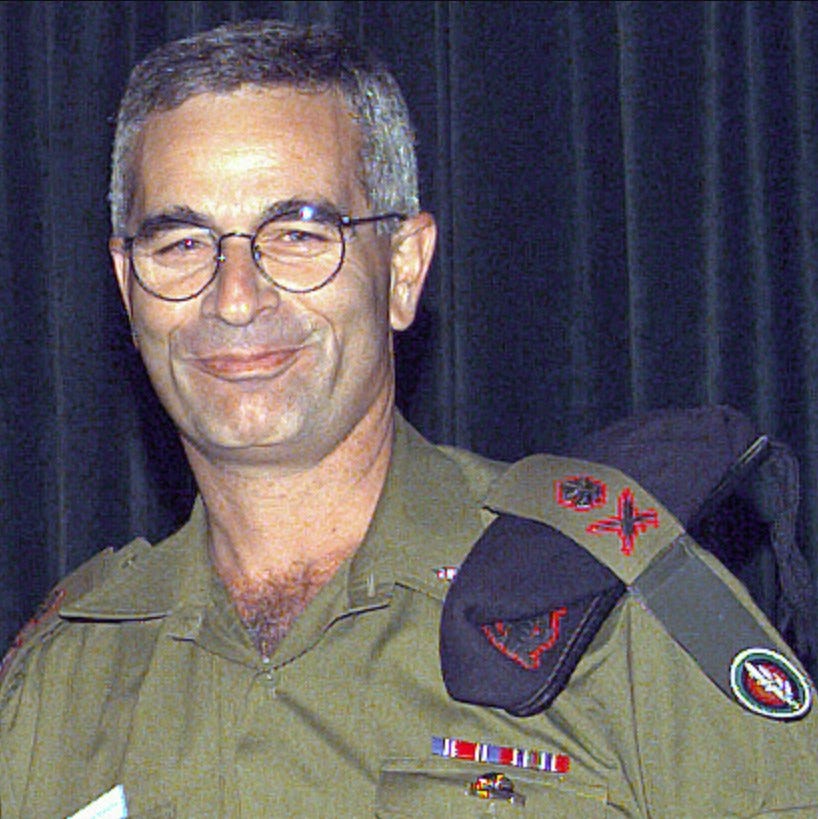
Former IDF intel chief Amos Malka, pictured in 1997 (US Department of Defense/Wikipedia).

My rule of thumb is that the CIA’s operations draw criticism from the left and its analysis draws criticism from the right. The formula that seems to be holding up in the wake of this story from the FT:
The CIA’s associate deputy director for analysis changed her Facebook cover photo on October 21 to an image of a man waving a Palestinian flag that is often used in stories criticising Israel. The Financial Times has decided not to name her after the intelligence agency expressed concern about her safety.
Posting an overtly political image on a public platform is a very unusual move for a senior intelligence official.1
Predictably, the name of the official is all over conservative media in the US. Whilst the Facebook posts were surely unwise, they are a slim basis for drawing conclusions about CIA analysis.
Indeed, the controversy has overshadowed a more substantive contribution from a former CIA official who held the more senior post of Deputy Director for Analysis until April. Writing in Barrons, Linda Weissgold gave this perspective on the conflict:
I consistently have said that we cannot want peace more than those involved. That is because Middle East peace isn’t a simple real estate deal. Religion, past grievances, and a sense of legacy affect any rational actor calculus. Yasser Arafat’s refusal in 2000 to meet Israel’s far-reaching territorial compromises because, as President Clinton said in his memoirs, Arafat “couldn’t bring himself to say yes” proved this to me.2
This interpretation may be common in the US, but was surprisingly contentious within Israeli intelligence at the time. In 2004, a number of Israeli military intelligence officers called for ‘a formal inquiry into the possibility that the government was misled into believing it was not possible to make peace with Palestinian President Yasser Arafat.’3
They included Amos Malka, the head of military intelligence at the time of the negotiations, and the head of the branch dealing with Palestinian affairs, Ephraim Lavie, who claimed that there were no written or official assessments backing the ‘no partner’ position. 4
According to Haaretz's Akiva Eldar, it was the head of the research division of military intelligence, Amos Gilad, who provided the professional backing for the analysis which became dominant.
The basis of this theory: Barak made a generous offer to Palestinian Authority Chairman Yasser Arafat, and when the latter refused to accept it, his real face was exposed: that of a terrorist who aims at the destruction of Israel.
This theory - which has earned the well-known epithet konseptzia ("conception" - harking back to mistaken assessments prior to the Yom Kippur War) in the intelligence community - is believed by most Israelis today and has also won many fans abroad.5
Gilad’s boss, Malka, was no straightforward dove, and was seen as a critic of Israel’s unilateral withdrawal from Lebanon in the months before the Camp David summit in 2000.6 Nevertheless, he had a very different assessment of the Palestinian position.
We assumed that it is possible to reach an agreement with Arafat under the following conditions: a Palestinian state with Jerusalem as its capital and sovereignty on the Temple Mount; 97 percent of the West Bank plus exchanges of territory in the ratio of 1:1 with respect to the remaining territory; some kind of formula that includes the acknowledgement of Israel's responsibility for the refugee problem and a willingness to accept 20,000-30,000 refugees. All along the way ... it was MI's assessment that he had to get some kind of statement that would not depict him as having relinquished this, but would be prepared for a very limited implementation.7
Could the Israeli - and American - intelligence failure of October 2023 be rooted in the same ‘konzeptiya’ which became dominant in 2000, one which saw unilateral disengagement as a more viable path forward than political negotiations?
Undoubtedly, the conditions for a peace process are much more difficult today than even in 2000. That is where Weissgold’s analysis of the political weakness of the Palestinian Authority is all too credible.
Demetri Sevastopulo and Felicia Schwartz, Senior CIA official posted pro-Palestine image on her Facebook page, Financial Times, 29 November 2023.
Linda Weissgold, Americans Pushing for Peace in Gaza Are Making Two Analytical Mistakes, Barrons, 28 November 2023.
Israeli Military Intelligence Assessments of Yasser Arafat, Voice of America, 13 June 2004.
Israeli Military Intelligence Assessments of Yasser Arafat, Voice of America, 13 June 2004.
Akiva Eldar, Popular Misconceptions, Haaretz, 5 August 2004, archived at the Internet Archive.
Seth J. Frantzman, Twenty years after Lebanon withdrawal: Return to the abyss, Jerusalem Post, 21 May 2020.
Akiva Eldar, Popular Misconceptions, Haaretz, 5 August 2004, archived at the Internet Archive.