
Labour MPs push for UK intelligence oversight

Welcome! I’m Tom Griffin and this is my intelligence history newsletter. Feel free to share this article with the button below.
Please also check out my previous post: Endgame: Aldrich Ames, Oleg Gordievsky and the last round of the Cold War. My next subscriber profile is likely to be on the CIA’s Mexico City Station, a large subject.
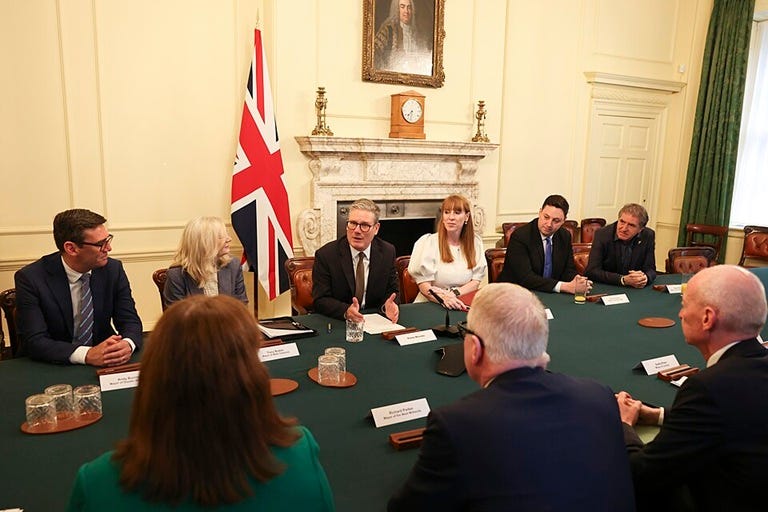
Prime Minister Keir Starmer (centre) meeting metro mayors after his election in 2024. Manchester Mayor Andy Burnham (top left) and Liverpool Mayor Steve Rotherham (top right) have pushed for the Hillsborough law to apply to the intelligence services (Simon Dawson / No 10 Downing Street, OGL 3.0).
.jpg)
When the Labour Party returned to power in Britain last year, I noted that it had a long and complicated history with the intelligence services. Another chapter in that story is being written this week.
In its election manifesto, Labour promised to introduce a ‘Hillsborough Law’ placing a legal duty of candour on public servants and authorities, and provide legal aid for victims of disasters or state related deaths
The name refers to the 1989 Hillsborough stadium disaster, which saw 97 football football supporters killed in a crowd crush. A public inquiry later found that the police had blamed Liverpool fans for their own failure of crowd control.
On Monday, The House of Commons is due to debate the Public Office (Accountability) Bill, which will give effect to the Hillsborough Law. The bill requires public officials to notify inquiries or investigations when they have relevant information, but includes the following carve-out for intelligence:
Security and intelligence information
(1) The duty of candour and assistance applies to an intelligence service as it applies to other public authorities.
(2) But the obligation to give a notification under section 2(3) does not apply—
(a) to a person who works for an intelligence service, or where compliance with that obligation would result in the provision of information relating to security or intelligence, within the meaning given by section 1(9) of the Official Secrets Act 1989.
(3) The head of each intelligence service must ensure that the service has in place arrangements designed to secure that persons who work for the service comply with the service’s procedures for—
(a) maintaining a record of information in relation to any acts that are or may be relevant to an inquiry or investigation, including one which may take place in the future, and
(b) informing the service that they have information (if not otherwise available to the service) that is or may be relevant to an inquiry or investigation.
The relevant bit of the Official Secrets Act states:
“security or intelligence” means the work of, or in support of, the security and intelligence services or any part of them, and references to information relating to security or intelligence include references to information held or transmitted by those services or by persons in support of, or of any part of, them.
Ultimately, under these plans, it will be the heads of MI5, MI6 and GCHQ who have the power to determine what information their services provide to public inquiries. That has faced objections from families of those killed in the Manchester Arena bombing in 2017. An inquiry into the attack found that MI5 had not given an ‘accurate picture’ of the intelligence it held on suicide bomber Salman Abedi, who killed 22 people. Campaigners believe that the new law will not make a difference in such circumstances unless it applies to individual intelligence officers.
The intelligence services are clearly a unique case, given the centrality of secrecy to their work, but if that rules out effective external oversight, then the duty of candour effectively becomes voluntary.
One would normally expect a government with such a large majority to be able to brush such concerns aside. However, Starmer’s Downing Street has been unusually ham-fisted in its handling of the Parliamentary Labour Party, and the Hillsborough and Manchester Arena campaigns are resonant issues in cities which are traditional Labour strongholds.
Manchester Mayor Andy Burnham, a key supporter of both campaigns, is a potential leadership rival to Keir Starmer. No doubt, the lobby correspondents will be looking at the size of any rebellion tomorrow in those horse-race terms. Those on the intelligence beat will be equally interested to see how far MPs cast off their usual reticence on the subject.
Update: The Guardian reports that the Government has backed down on the eve of the debate:
The government has decided not to move its amendment on Monday, but to instead work with campaigners and the bereaved to bring forward amendments when it reaches the Lords, it is understood. The bill will still return to the Commons for its report stage and third reading as planned.
Scholar Dan Lomas has argued that Labour scepticism has been a driving force for past intelligence reforms.
Even if the party’s calls for change were often rooted in the deep-seated mistrust of the ‘secret state’ and stemmed from misapprehensions based on personal experience – as the Benn example shows, Labour’s calls to bring the agencies into a legal framework and establish a parliamentary system of oversight had at heart what is now regarded as a liberal democratic norm in the context of intelligence oversight.
The Hillsborough Law might yet be another episode in that process.