
No friends in intelligence
The US allies spying on Washington

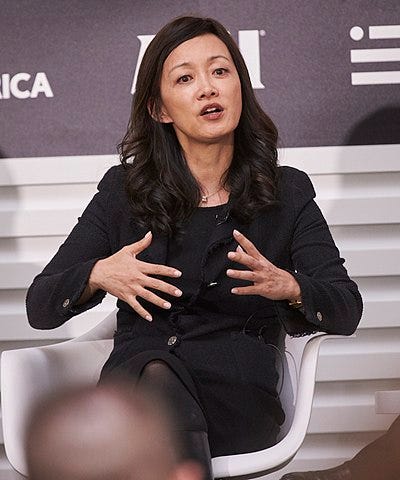
Sue Mi Terry in 2018 (Eric Gibson/ New America, CC2.0).

One key intelligence case came to an end in Manhattan on Tuesday, and another began. The former chair of the Senate Foreign Relations Committee, Robert Menendez (D-New Jersey), was convicted of 16 charges, including acting as an agent of the Egyptian government, obstruction of justice, wire fraud and extortion.1
The same day saw the indictment under the Foreign Agent Registration Act of Sue Mi Terry, a former CIA analyst who is married to Washington Post columnist Max Boot.2
The head of the FBI’s New York Field Office, Christie M. Curtis said of this case:
For over a decade, despite repeated warnings, Terry allegedly exploited her think tank roles to advance a foreign agenda. As alleged, she disclosed sensitive U.S. government information to South Korean intelligence and used her position to influence U.S. policy in favor of South Korea… for money and luxury gifts. Her alleged actions posed a severe threat to national security.3
The two cases have a striking commonality. They both involve US allies, and intelligence agencies with long standing links to the CIA.
Of the two countries involved, Egypt has had a much rockier relationship with the US, but even during Nasser’s Cold War tilt to the Soviet Union, his General Intelligence Service (EGIS) never fully broke off the CIA liaison relationship established in the 1950s.4
According to Miles Copeland, an early officer of the CIA’s Cairo station, EGIS was designed from the beginning using ‘American management-engineering methods’ and its intended role co-ordinating the Egyptian intelligence community was modelled on its US counterpart.5
South Korea’s National Intelligence Service was originally established in 1961 as the Korean Central Intelligence Agency (KCIA). This might suggest a similar history of American tutelage, although the CIA later denied involvement in its formation to investigators from the US House of Representatives.6
That House investigation found in 1978 that the KCIA had been central to a campaign of ‘extraordinary measures’ over the previous decade, in order to oppose the Nixon Administration’s attempts to draw down US forces in Korea, and to counter negative publicity about domestic repression under President Park Chung Hee.7
In 1977, Richard Halloran of the New York Times concluded that at least 115 Congressmen had received contributions or other favours as part of the lobbying effort.8 Halloran dubbed it the 'Intrepid’ project, referencing the codename of Sir William Stephenson, who led British Security Co-ordination in New York during the Second World War.9
The South Koreans themselves seem to have learned from previous covert influence operations. Former KCIA director Kim Hyung Wook testified that he had been inspired by the success of Anna Chennault's China Lobby on behalf of Taiwan-based nationalists. Korean documents also suggested an attempt to dovetail with lobbyists working for Israel.10
The 1978 report concluded that the KCIA had curtailed its activities in response to investigation, but ‘found no indication that the “low profile” represented anything but a tactical reaction to events, which could be reversed in the absence of pressure from U.S. authorities.’11
In a 1996 paper on the episode, historian Bruce Cumings wrote that 'like so many American scandals, no one ever quite got to the bottom of Koreagate.' He pointed to the political clout of Rev. Sun Myung Moon's Unification Church, despite the close links between Moon and the KCIA reported by the 1978 investigation.12
The FBI’s latest accusations suggest little has changed, and there remains a great deal of truth in the principle recorded by renegade CIA officer Philip Agee: ‘There is no such thing as a friendly intelligence service.’13
Benjamin Weiser, Tracey Tully, Nicholas Fandos and Maria Cramer, Menendez Convicted of Corruption in Broad International Conspiracy, New York Times, 16 July 2024
Claire Fahy, Jesse McKinley and Benjamin Weiser, U.S. Accuses Former C.I.A. Analyst of Working for South Korea, New York Times, 16 July 2024.
Former Government Official Arrested For Acting As Unregistered Agent Of South Korean Government, United States Attorney's Office, Southern District of New York, 17 July 2024.
Owen L. Sirrs, A History of the Egyptian Intelligence Service: A history of the mukhabarat, 1910–2009, Routledge, 2010, p.109.
Miles Copeland, The Game of Nations: The Amorality of Power Politics, Simon & Schuster, p.97.
Investigation of Korean-American relations: report of the Subcommittee on International Organizations of the Committee on International Relations, U.S. House of Representatives, 31 October 1978, p.89.
Investigation of Korean-American relations: report of the Subcommittee on International Organizations of the Committee on International Relations, U.S. House of Representatives, 31 October 1978, pp.3-4. Archived at the Internet Archive.
Richard Halloran with Marjorie Hunter and Jo Thomas, ETHICS PANEL FINDS MORE CONGRESSMEN TOOK KOREAN FAVORS, New York Times, 11 July 1977.
Richard Halloran, Seoul's Target Circle Was Much Wider Than Washington, New York Times, 4 December 1977.
Investigation of Korean-American relations: report of the Subcommittee on International Organizations of the Committee on International Relations, U.S. House of Representatives, 31 October 1978, p.111.
Investigation of Korean-American relations: report of the Subcommittee on International Organizations of the Committee on International Relations, U.S. House of Representatives, 31 October 1978, p.113.
Bruce Cumings, JPRI Working Paper No. 20: Korean Scandal, or American Scandal? Japan Policy Research Institute, 1996.
Philip Agee, Inside the Company: CIA Diary, Penguin, 1975, p.62.