
The Khashoggi Connection
Saudi-American Realpolitik from the 1960s to the 2020s

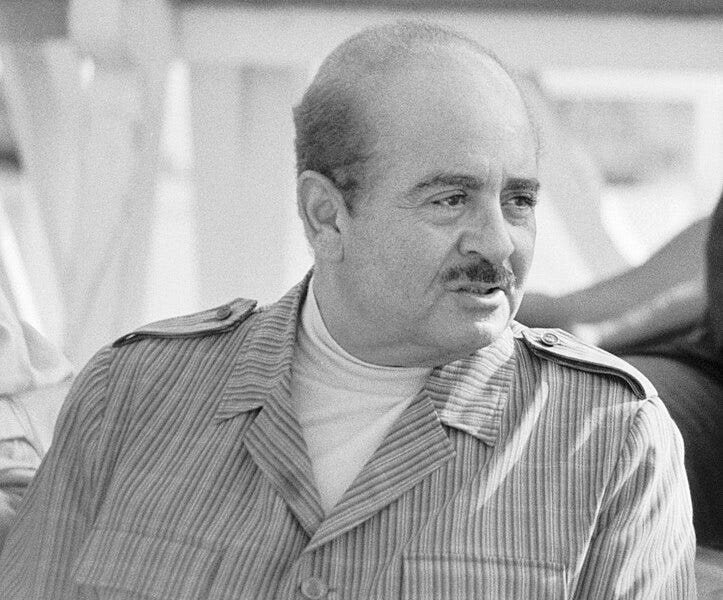
Adnan Khashoggi in the 1980s (Roland Godefroy, CC3.0).

A diplomatic ‘grand bargain’ between Israel and Saudi Arabia has been a key aim of US policy in the Middle East since at least 2020, when the Trump administration’s Abraham Accords normalised Israeli relations with the UAE and Bahrain.
The Hamas attack on 7 October last year was widely seen as a blow to that prospect. The Biden administration, however, has sought to incorporate the normalisation agenda into its attempt to end the new round of conflict.
The Atlantic’s recent long-read on the ceasefire negotiations featured an intriguing vignette on Secretary of State Anthony Blinken’s attempt to revive normalisation during a meeting with Crown Prince Mohammed bin Salman. The prince, commonly known as ‘MBS’, insisted on the need for Palestinian statehood as part of the deal.
“Seventy percent of my population is younger than me,” the 38-year-old ruler explained. “For most of them, they never really knew much about the Palestinian issue. And so they’re being introduced to it for the first time through this conflict. It’s a huge problem. Do I care personally about the Palestinian issue? I don’t, but my people do, so I need to make sure this is meaningful.” (A Saudi official described this account of the conversation as “incorrect.”)1
This story reminded me of another Saudi-American meeting some 57 years earlier, recounted by former CIA officer Miles Copeland. By 1966, Copeland had parlayed his Middle East expertise into a lucrative consultancy. As a result, he was one of a select group of Americans who met arms dealer Adnan Khashoggi ahead of a visit to Washington by King Faisal. The head of the CIA’s Commercial Contacts Division, Jim Critchfield, was among the others.
Copeland recalled:
..’Adnan surprised them. He said that although King Feisal could hardly admit it publicly, he had no effective feelings one way or the other about Israel —anyhow, no feelings that might motivate him to action — and that the money that the Saudis were beginning to pour into their coffers in the form of oil revenues would be spent on projects that would enable them to ‘live and let live’. He admitted that some Saudi money would have to be paid to the Syrians and Palestinian resistance groups, but only in the way storekeepers pay ‘protection money’ in areas where there is insufficient police protection, but even this outpouring could be discontinued when the police protection was forthcoming.2
Perhaps neither of these narratives are wholly reliable. If nothing else, they testify to an enduring American perception of Saudi realpolitik.
There is a darkly ironic connection between the two accounts. In 2018, Khashoggi’s son Jamal was murdered in the Saudi consulate in Istanbul. The CIA reportedly concluded that King Faisal’s nephew, MBS, was responsible.3
The Biden administration was initially hostile to the Saudi government as a result.
Biden took office spoiling for a fight with the Saudis. During the campaign, he had announced his intention of turning the kingdom into a “pariah.” But after McGurk explained the sanctions that the administration was about to impose on Saudi Arabia, he found himself on the receiving end of one of the prince’s flights of enthusiasm. MBS disarmed McGurk by announcing his desire to normalize relations with Israel, following the path that the United Arab Emirates and Bahrain had traveled a few months earlier with the signing of the Abraham Accords.4
MBS’ alleged fears for his own safety suggest that the ‘grand bargain’ is a much more difficult proposition than the quiet rapprochement that Adnan Khashoggi offered in the 1960s. The domestic Saudi dissent he described is a more challenging problem for US ‘police protection’ than deterring regional rivals.
For Khashoggi’s American friend, Miles Copeland, the Israel/Palestine question belonged to class of problems, which ‘like the square root of minus one, are utterly insoluble. When they are recognized as such, their resistance to solution must be instantly recognized, and the strategists must drop all notions of solving them and shift their attention to the question of how to minimize the adverse consequences of the problem’s going unsolved.’5
Despite the efforts of the Biden administration to graft on a Palestinian dimension, the goal of a grand bargain modelled on the Abraham Accords owed something to that approach.
When the US National Security Advisor Jakes Sullivan proclaimed a year ago that ‘the Middle East region is quieter today than it has been in two decades’, it might even have seemed to be working.6 It’s much harder to reach that conclusion today.
Franklin Foer, The War That Would Not End, The Atlantic, 5 October 2024.
Miles Copeland, The Game Player: Confessions of the CIA’s Original Political Operative, Aurum Press, 1989, p.229.
Shane Harris, Greg Miller and Josh Dawsey, CIA concludes Saudi crown prince ordered Jamal Khashoggi’s assassination, Washington Post, 16 November 2018.
Franklin Foer, The War That Would Not End, The Atlantic, 5 October 2024.
Miles Copeland, The Game Player: Confessions of the CIA’s Original Political Operative, Aurum Press, 1989, p.80.
Quoted in Gal Beckerman, ‘The Middle East Region Is Quieter Today Than It Has Been in Two Decades’, The Atlantic, 7 October 2023.