
George Kennedy Young
Vice-chief of MI6 1958-61

Welcome! I’m Tom Griffin and this is my intelligence history newsletter. Feel free to share this article with the button below. If this email is truncated, please check the website.
On a personal note, I’m in the market for freelance work at the moment, so do check out my new Archival Research Services page if you have a project I can help with.
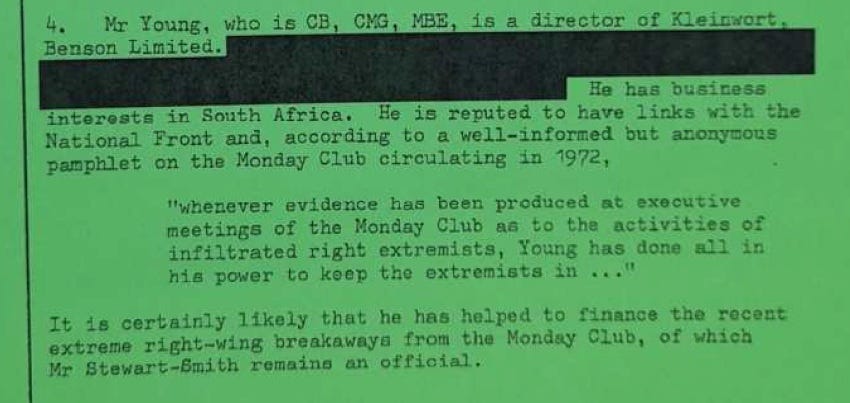
The Information Research Department on former MI6 vice-chief George Kennedy Young (J.E. Tryer to Thomas Barker, 5 February 1974. National Archives FCO 168/7075).
George Kennedy Young (1911-1990) was vice-chief of the Secret Intelligence Service, MI6, from 1958 until 1961.1
After a successful wartime career in military intelligence in East Africa and Italy, Young joined the peacetime service as station chief in early Cold War Vienna. During the 1950s, he was at the centre of the service’s attempts to shore up British political influence through covert action. As Middle East Controller he presided over MI6’s role in the overthrow of Iran’s President Mossadegh in 1953. He was also implicated in assassination plots against President Nasser of the Egypt. He was profoundly disillusioned by the failure of the Anglo-French invasion during the Suez Crisis of 1956. He later said ‘I became an old man overnight’.2
After leaving MI6, he emerged as a key figure on the racist far-right of the Conservative party, through a succession of vehicles including the Monday Club, the vigilante group Unison and the activist network Tory Action.
Early Life
George Kennedy Young was born in Dumfries on 8 April 1911.3 Anthony Cavendish described him as ‘very much a Scottish borderer of Covenanting stock on both sides of his family, with a strong tradition of dissent and independent thinking.’4
At St Andrews University, he earned First Class Honours in Modern Languages and medals in French and German. As a Commonwealth Fellow at Yale, he earned a Research MA in Political Science.5
He began his working life as a journalist with the Glasgow Herald.6 He also worked as a sub-editor with American papers, and as a cable editor of British United Press (BUP). He later recalled being contacted by the Air Ministry to follow up BUP reports on the German Air Force, lifted from the Essener National Zeitung.7
Second World War
During the Second World War, Young served in the King’s Own Scottish Borderers, from which he was seconded to the King’s African Rifles, arriving in East Africa in January 1941. On the basis of his limited Italian, he was posted to General Staff Intelligence and sent to join the 11th African Division in Italian Somaliland. As the division advanced, he divided his time between prisoner interrogations, examining captured documents, and security and counterintelligence duties.8
A key breakthrough came with the capture of Major General Santini outside Addis Ababa. When Young was asked how he managed to get so much intelligence about the opposing force from the prisoner, he said ‘we in intelligence, we have our methods.’ In fact, Santini had volunteered his information rather freely.9
