
Mandelson case tests Westminster intelligence oversight
MPs give new mandate to Intelligence and Security Committee

Welcome! I’m Tom Griffin and this is my intelligence history newsletter. Feel free to share this article with the button below.
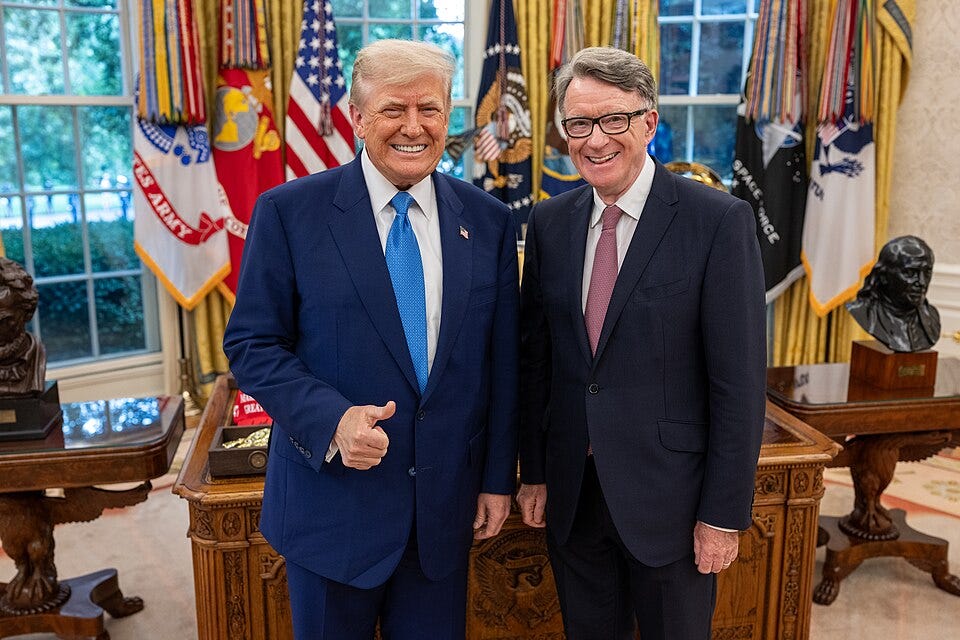
President Trump receiving the credentials of British Ambassador Peter Mandelson on 11 June 2025. The British Parliament is expected to publish Mandelson’s communications from this period in the coming months (UKinUSA, CC2.0).
It has become increasingly noticeable in recent days that the Epstein files are doing more damage to political careers in Europe than in the US. Nowhere more so than in Britain, where they have already felled the Duke of York and Lord Mandelson of Foy and Hartlepool, the former British Ambassador to the United States.
The latest files have also inflicted a deep wound on Keir Starmer, over his decision to send Mandelson to Washington. We could yet see a British Prime Minister losing office while Donald Trump remains untouched. This is perhaps less a reflection of European rigour than of the Department of Justice’s release policy, as legal commentator David Allen Green has suggested.
On Wednesday, the House of Commons passed a motion known as a ‘humble address’, demanding sight of all government documents related to Mandelson’s appointment. Past such motions have included an exemption for national security. This time, however, MPs from across the house voted to allow the most sensitive documents to be reviewed by Parliament’s Intelligence and Security Committee (ISC).
A similar move would have been much less unusual in the US where the Congressional Intelligence Committees have been powers in the land since the 1970s. Only this week we have seen the vice chair of the Senate Intelligence Committee, Mark Warner, demanding briefings over the involvement of DNI Tulsi Gabbard in a domestic FBI search, and one of his colleagues, Ron Wyden, writing a classified letter to CIA director John Ratcliffe expressing concern about unspecified agency activities.
The ISC is a very different beast. Unlike normal parliamentary select committees, its members are nominated by the Prime Minister in consultation with the leader of the opposition. It’s chair, Lord Beamish complained last year about the ‘control exerted over the Committee’s staff and resourcing by the Cabinet Office’, the department at the heart of British Government machinery which houses the Committee’s own offices.
During Wednesday’s Commons debate, deputy ISC chair Jeremy Wright extracted a promise from the Government that extra resources would be provided to consider the Mandelson documents.
The direct tasking of the ISC by the Commons is a constitutional novelty which has strengthened the Committee’s hand. Conversely, it reveals the weakness of the Prime Minister whose authority is based on Labour’s Commons majority.
Starmer came into office with the image of a reforming human rights lawyer. In areas informed by his legal expertise, and that of his attorney-general, Lord Hermer, that image has had some substance.
Elsewhere, however his Government has often had the air of a restoration, reliant on an ancién regime party establishment returning from exile under Jeremy Corbyn. Mandelson was at the centre of that old guard. As Trade and Industry Secretary in 1998, he told Silicon Valley executives that: “We are intensely relaxed about people getting filthy rich. As long as they pay their taxes.”
It has been suggested that Mandelson was appointed not in spite, but because of his links to Epstein, and hence to the moneyed elite about Trump. There is no doubt that Trump’s presidency has been a defining constraint for Starmer’s Government, but that seems to me at least in part a rationalisation. Mandelson wanted the job and had the influence to get it. That tells us as much about the British elite as about the American one.
The influence of Labour’s own donor class was evident in opposition, when the party dropped plans to ban foreign political donations. Much of that agenda has been re-adopted in Government, but the party may now have to go much further in its efforts to regain public trust.
The difficulties of navigating the US-UK relationship under Trump are only likely to be compounded as Mandelson’s communications from Washington are made public over the coming months. British diplomats will fear that they could be as damaging as the leaked criticisms which forced Sir Kim Darroch’s resignation as Ambassador in 2019.
* The latest files have reignited the discussion about Epstein’s intelligence connections, a debate which tends to be an index of the debaters’ geopolitical preoccupations. Advocates of the Russia theory can be point to his relationship with the FSB-trained former minister Sergei Belyakov. Proponents of the Israel theory can cite his links to former Aman chief and Israeli Prime Minister Ehud Barak.
There is a useful discussion of the question over two recent episodes of the Rest is Classified podcast. Former CIA analyst David McCloskey and BBC security correspondent Gordon Corera find no evidence that Epstein was a recruited agent or that his abuse network was a state-controlled intelligence operation. They nevertheless suggest that he could have been a useful contact for many intelligence agencies, not least because of his potential as an access agent.
Less a spy then, more an inhabitant of the intelligence demi-monde. Yet in scandals from BCCI to Iran-Contra, the machinations of that world have sometimes been as consequential as those of what Ian Fleming called ‘civil servant spies’, partly perhaps in a counter-movement to the rise of intelligence oversight.